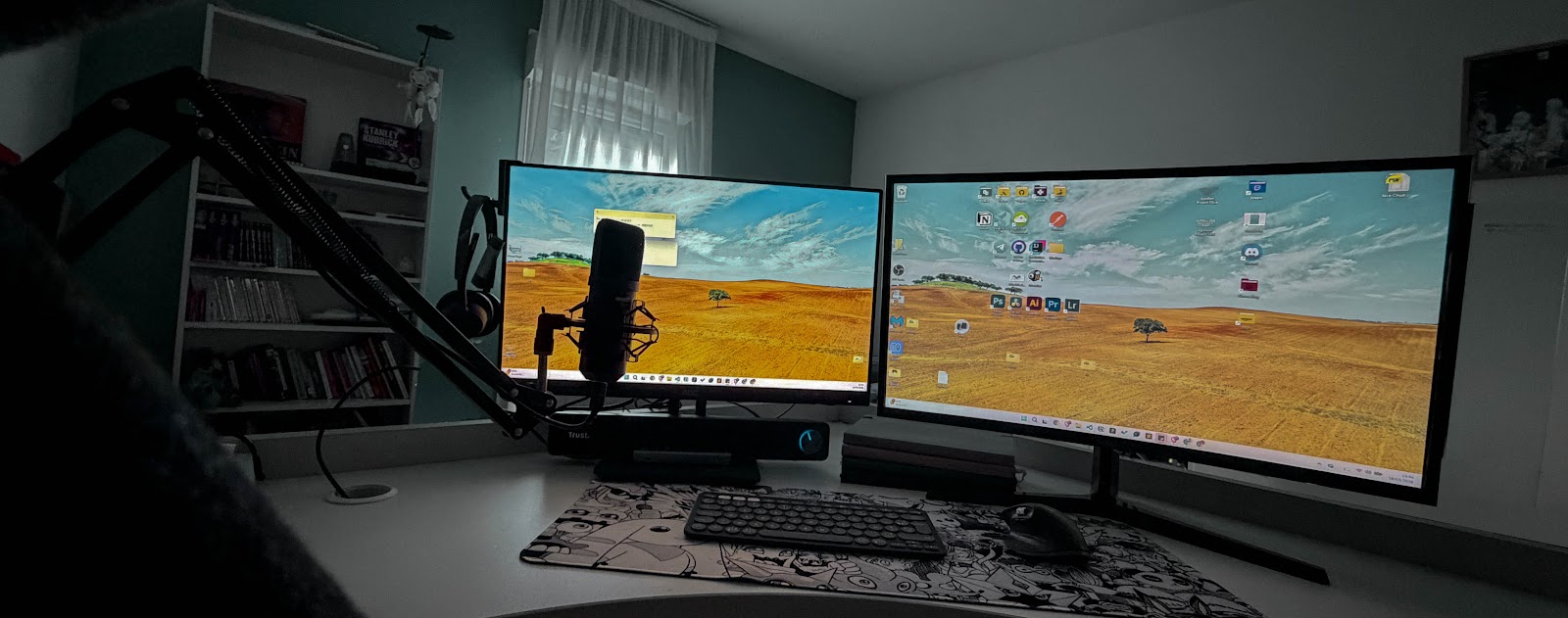
Workstation
- The Brain: Lenovo Workstation (32GB RAM). High-capacity memory is essential for running local Docker clusters and Spring Boot services without the OS breaking a sweat.
- The View: A 27” Samsung Curved for primary code, paired with a vertical 24” AOC for documentation and real-time logs. The vertical layout is a game-changer for reading long stack traces.
- The Hands: Logitech MX Master 3 for precision macros + Pebble Keys 2 for a quiet, minimalist desk footprint.
- The Voice & Video:
- Poly Voyager 4320: Clear audio is non-negotiable when translating complex technical needs into business reality.
- Logitech StreamCam: 60fps clarity for remote collaboration. High-quality video is my baseline for maintaining a professional presence.
- The Seat: IKEA Gruppspel. Because an engineer is only as good as his back allows him to be after a long sprint.
- The GPU: NVIDIA Quadro M2000. A professional workhorse for high-resolution UI/UX exports and filmmaking. It ensures smooth rendering and 4K playback.
Software & Design
- Development: IntelliJ IDEA & VS Code. IntelliJ is my powerhouse for deep Java/Spring Boot architecture. VS Code handles my frontend work, customized with the Cobalt2 theme for maximum visual clarity.
- Terminal: Warp. A recent switch from Windows Terminal. It’s an AI-powered, Rust-based terminal that treats commands as “blocks.” I’ve moved here for the “Agentic” workflow—using natural language to handle complex CLI tasks and refactoring.
- Design & Creative: Figma & Adobe Creative Cloud. I treat Figma as a blueprint, focusing on Design Systems for code consistency. Creative Cloud handles the heavy lifting for high-resolution assets and filmmaking.
- Infrastructure: Docker. I containerize almost everything to ensure my local Windows environment perfectly mirrors the production environment.
- AI & Browsing: Gemini & Arc. I leverage Gemini for rapid prototyping and complex refactoring logic. Arc is my primary browser for its “space-based” workflow, keeping docs and dev-tools organized.
- Documentation: Docusaurus. My choice for building structured, versioned technical documentation that stays maintainable and readable.
- Planning: Notion & Jira. Notion for my “Second Brain” and internal knowledge; Jira for the cold, hard reality of the sprint.
The Library
- So Good They Can’t Ignore You — Cal Newport. My blueprint for building career capital through mastery and deliberate practice.
- Don’t Make Me Think — Steve Krug. My go-to lens for usability; if a user has to pause to figure out a button, the design has failed.
- A Philosophy of Software Design (2nd Ed) — John Ousterhout. A masterclass in managing system complexity. It’s the standard for “strategic programming.”
- The Science of Storytelling — Will Storr. Understanding how the brain structures information to build better, more intuitive user journeys.
- Rebel Without a Crew — Robert Rodriguez. The ultimate guide to resourcefulness and the “hacker” mindset in any creative or technical field.